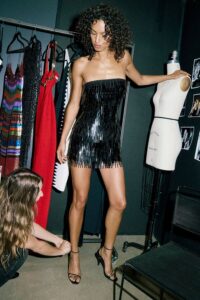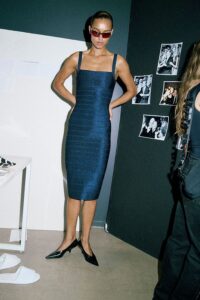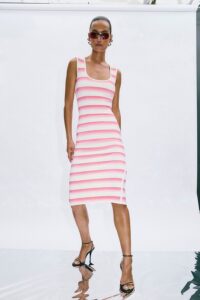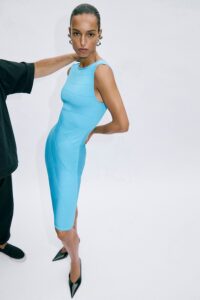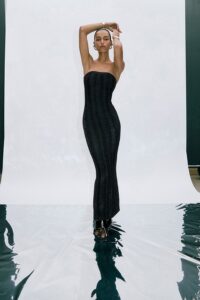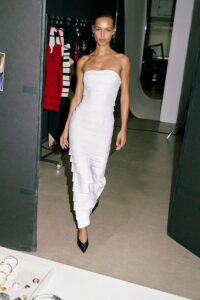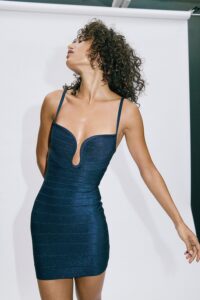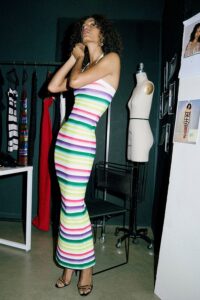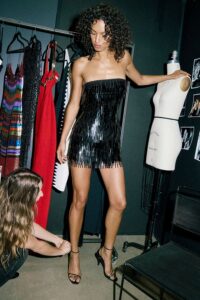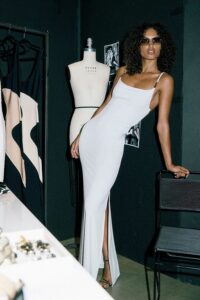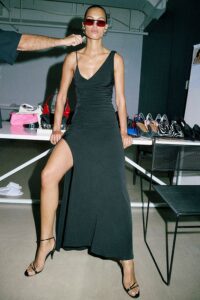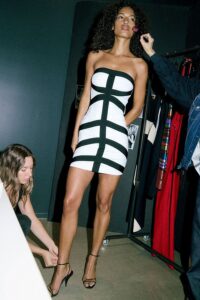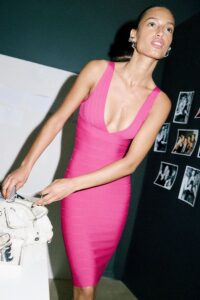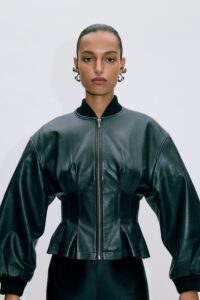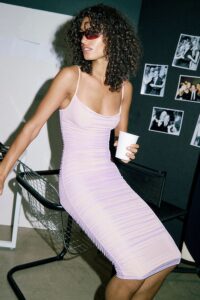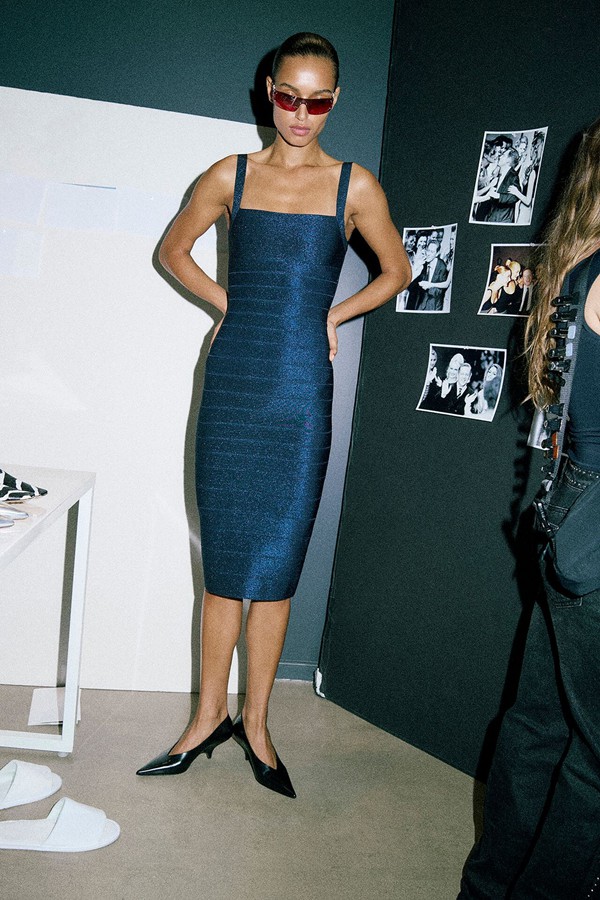
Hervé Léger Spring Summer 2026 collection lookbook introduced at New York Fashion Week SS26.
Hervé Léger’s Spring Summer 2026 lookbook, unveiled during New York Fashion Week SS26, continues the label’s dialogue between archival codes and contemporary youth energy, presenting a sequence of garments that read as both celebration and recalibration of the brand’s hallmark silhouette. Michelle Ochs, who has steered the house for two years, mines the archive with deliberate affection: familiar techniques—bandage construction, body-conscious tailoring, and the optical play of twisted strips—are reframed through updated fabrications and unexpected surface treatments so the lookbook reads as a lineage rather than a repetition.
The collection opens with a statement mini that revisits the bandage vocabulary in a playful key. Narrow twisted strips trace and fragment the torso in rhythmic bands, producing a structured yet kinetic surface that sculpts the wearer while allowing for small panels of negative space. The piece exemplifies Ochs’s refinement of Léger’s core idea: a dress that is simultaneously architectural and sensuous, resolving support and exposure in a single silhouette. Several subsequent minis continue that conversation, varying hem lengths and strap placements while retaining the snug, contoured fit that defines the house identity.
Mesh reemerges as a connective tissue throughout the season, explicitly referencing a 1994 collection that used mesh overalls and inlays. Here mesh appears as shirred overlays, draped panels, and inlaid lattice that softens the bandage’s rigidity and introduces a diaphanous counterpoint. In some looks the mesh is almost sculptural—gathered and ruched across hips or wrapped to create a secondary skin—while in others it functions as a delicate veil over fully lined bases, producing a layered translucency that reads both youthful and refined.
Booty shorts paired with cropped tops recur as a dominant set of coordinates, nodding to the street-to-stage moment seen on celebrities and performers. These two-pieces are executed in a range of materials from high-shine coated knits to matte woven blends, with waistbands and seamlines engineered to hug and accentuate the torso. Thigh-high boots, often in matching finishes, extend the leg line and amplify the collection’s emphasis on elongation and physical dynamism. The styling suggests an ambivalence between performance costume and everyday glamour, a duality that has driven much of the label’s renewed public appetite.
Ochs also introduces more classical Léger references in evening pieces where the bandage motif is translated into sculpted gowns. These garments maintain the house’s commitment to body contouring but incorporate draping and asymmetric cutouts that soften the previously uniform striping. One gown uses diagonal paneling to create a spiral effect around the body, producing motion in stillness; another alternates opaque bands with sheer insets, balancing modesty and exposure without resorting to overt spectacle.
Color and texture are used strategically to underline the collection’s eras and intentions. A neutral base palette—creams, blacks, and warm beiges—anchors the line and nods to archival restraint, while punctuations of electric cobalt, hot pink, and acid yellow insert a contemporary, pop-inflected vitality. Surface treatments range from glossy patent-like sheens that catch light and movement to matte ribbed knits that emphasize tactile intimacy. Metallic accents and subtle hardware appear sparingly, largely as functional fastenings or tonal trims rather than focal points.
Tailoring makes several persuasive cameos: cropped blazers with pronounced shoulder darts, mini skirt suits with contoured waist seaming, and a few classic trench-inspired pieces reworked in stretch-fitted constructions. These looks quietly broaden the collection’s wardrobe applicability, suggesting that Léger’s body-centric language can be translated into structures beyond purely form-fitting dresses and performance sets.
Overall, the Spring Summer 2026 lookbook positions Hervé Léger as a house attentive to its past yet tuned into present consumer behavior. Ochs’s work leans into nostalgia—reanimated mesh, bandage riffing, and tight, seductive miniatures—while calibrating proportions and materials for contemporary movement and wearability. The collection reads as an offer to both longstanding followers of the brand and a younger audience attuned to pop-performance aesthetics: garments that privilege the body, celebrate motion, and present Léger’s defining codes in refreshed, occasionally playful permutations.