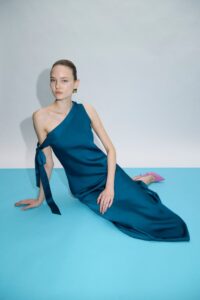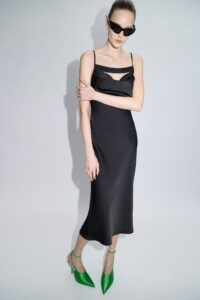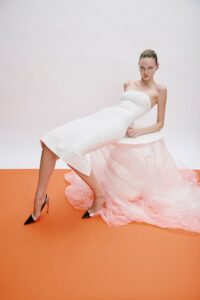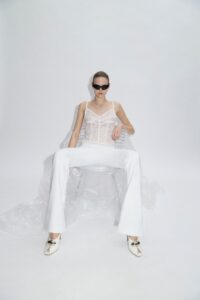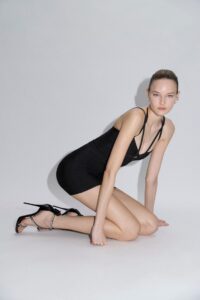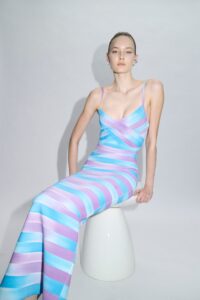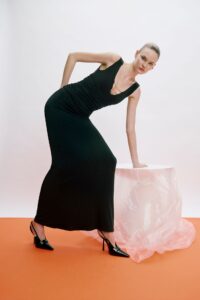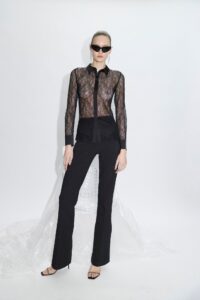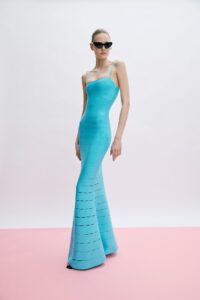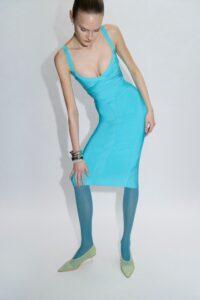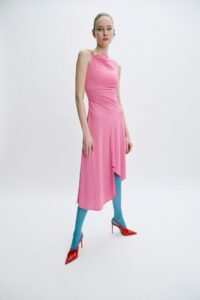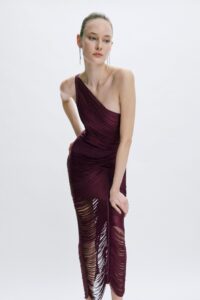
Hervé Léger Pre-Fall 2026 collection lookbook in 18 outfits.
Michelle Ochs enters her third year at Hervé Léger with a clear ambition: evolve the brand without severing its roots. Pre-Fall 2026 takes on that challenge across 18 looks, examining how far the house’s iconic bandage language can stretch while still remaining unmistakably Hervé. The result is a collection that reframes sensuality through modern techniques, softening the legacy of the bodycon silhouette without diluting its impact.
The lineup opens with pieces that immediately signal change. A black satin midi dress with a bias-cut line and a fluid cowl neckline introduces new movement into a house known for structure. Instead of a full bandage construction, a single horizontal strap across the collarbone acts as the connecting thread to the brand’s heritage. The experiment continues with an asymmetrical bubblegum-pink dress—draped, airy, and unexpectedly playful—anchored only by a ruched waist that nods to the original bandage system. Through these shifts, the collection expands its vocabulary, suggesting freedom rather than constraint, and a contemporary understanding of the Hervé woman.
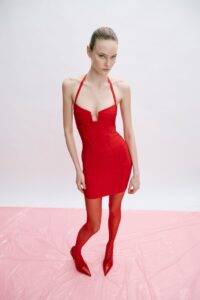
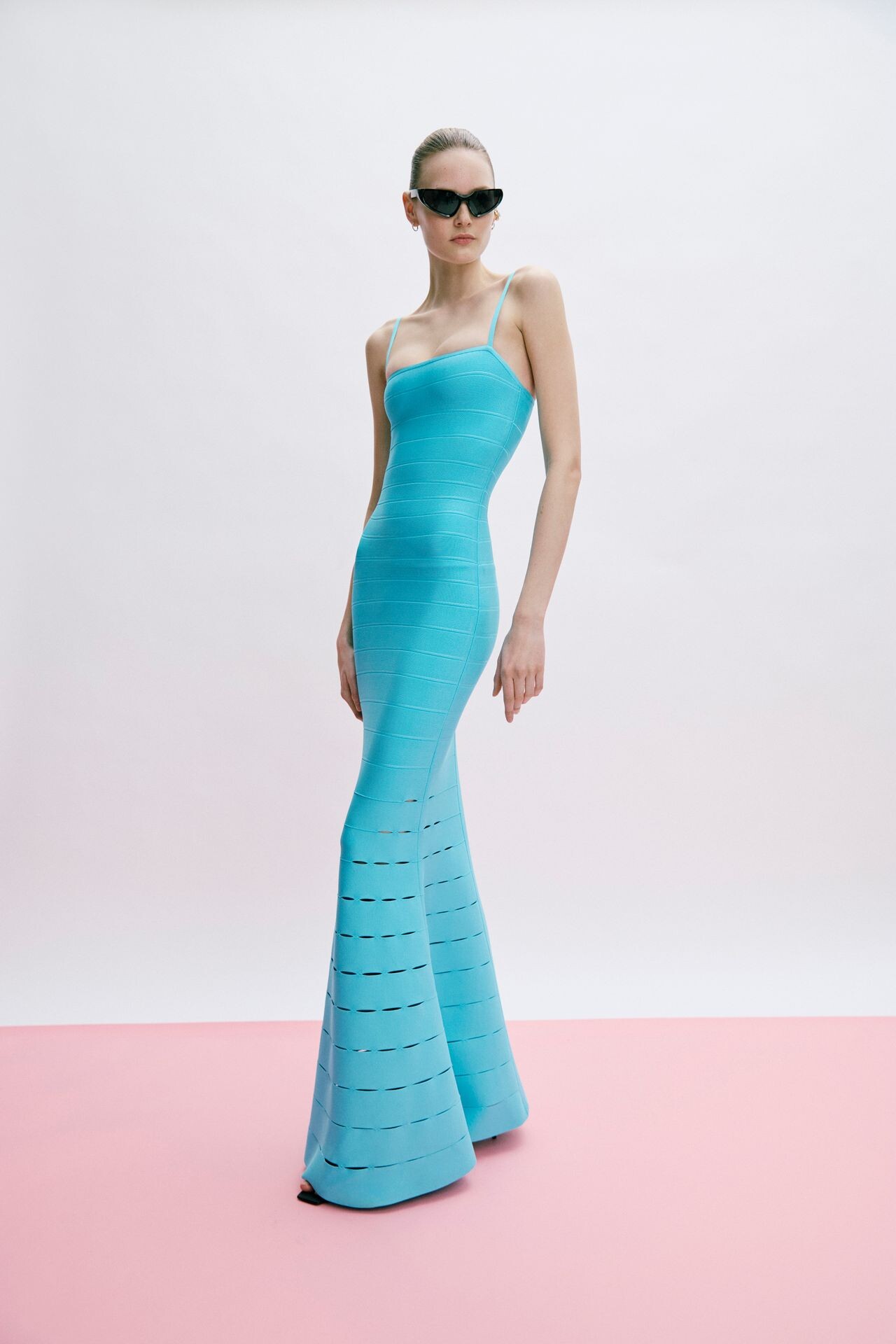
Still, the essence of the brand is far from abandoned. The lookbook carries forward the unmistakable heat associated with Hervé Léger: a scarlet halter engineered to sculpt the torso, a white minidress sharpened by a sheer plunge insert, and a teal maxi traced with perforated seams designed to contour the body. These silhouettes reaffirm the brand’s signature precision while subtly refining proportion, seeking a balance between intensity and restraint. Lace makes a notable appearance, incorporated in horizontal panels that mimic bandage layering—a technique revived from the archives and one of the season’s most successful reinterpretations.
Several looks dig more directly into the house’s core codes but push them into fresher territory. Panels widen or taper unexpectedly; surfaces shift from matte to reflective; and certain dresses introduce rounded or asymmetrical hems that soften the straight, powerful lines traditionally associated with the label. Across the 18 outfits, the collection moves between controlled curve-tracing and fluid drapery, suggesting a brand learning to breathe without losing its sculptural backbone. Even the more understated pieces—lean knit separates, delicate lace sheaths, sleek jersey gowns—feel intentionally calibrated, designed to expand the brand’s reach without confusing its identity.
As a whole, the Pre-Fall 2026 collection succeeds in positioning Hervé Léger for a new era. The critique lies only in the occasional tension between innovation and preservation, where the push for modernity competes with the legacy that defines the label. Yet the evolution feels steady, thoughtful, and increasingly confident. Ochs presents a wardrobe that acknowledges the past but insists on looking forward, proving that the brand’s iconic codes can remain powerful when approached with agility and care.